Start with the building problem
Before choosing foam type or thickness, identify the reason for the work: cold rooms, drafts, condensation, high energy bills, shop comfort, code requirements, noise, moisture control, or a remodel schedule.
The main cost variables
Spray foam is typically priced per board foot, and the total project cost is driven by a handful of variables: foam type (closed-cell costs more per inch than open-cell), coverage depth, total square footage, access difficulty, whether old insulation needs to be removed first, and how much prep and masking a space requires. A simple, easily accessed attic costs less to insulate per square foot than a tight crawl space or a finished area that requires careful masking of finished surfaces.
Why Park City costs can run higher than a valley-floor quote
Several factors specific to Park City and Summit County can affect pricing relative to a similar project in a lower-elevation, easier-access market: steep lots and limited equipment staging area, second-home and nightly-rental scheduling constraints, higher-end finish protection requirements on custom homes, and longer travel distances for crews serving outlying areas like Promontory, Jordanelle, or Hideout. None of these make a quote automatically higher, but they are worth mentioning up front so a contractor can price the job accurately the first time instead of revising after a site visit.
Closed-cell vs. open-cell pricing
Closed-cell foam generally costs more per board foot than open-cell foam because it is denser and delivers a higher R-value per inch, which can mean less material is needed to hit a target R-value in some assemblies. Many Park City projects use a mix — closed-cell where a vapor barrier and higher R-value matter (rim joists, crawl spaces, metal buildings) and open-cell where cost efficiency and sound control are the priority (interior walls, some rooflines). See closed-cell vs. open-cell spray foam for the technical comparison behind this cost trade-off.
Checking for available incentives
Some insulation upgrades may qualify for federal tax credits or utility efficiency programs, but eligibility rules, qualifying products, and available funding change over time. Verify current program rules directly with the IRS, your utility provider, or the State of Utah's energy office before assuming a project qualifies, and confirm whether any program requires a specific contractor certification or pre-approval before work begins.
Ask for specific scope notes
A useful quote should explain foam type, approximate depth, prep work, masking, removal of old material, ventilation, curing/re-entry guidance, ignition-barrier considerations, and whether any moisture or ventilation corrections are needed first. Run rough numbers before requesting a formal quote with the spray foam cost calculator.
Comparing quotes apples-to-apples
Because spray foam pricing depends so heavily on foam type and coverage depth, two quotes for the "same" job can differ significantly if one contractor is scoping closed-cell foam at a certain depth and another is scoping open-cell at a different depth. Ask each contractor to specify foam type, depth (in inches), and the resulting approximate R-value for each area of the project so quotes can be compared on the same terms rather than by total price alone.
Use related pages to narrow the request
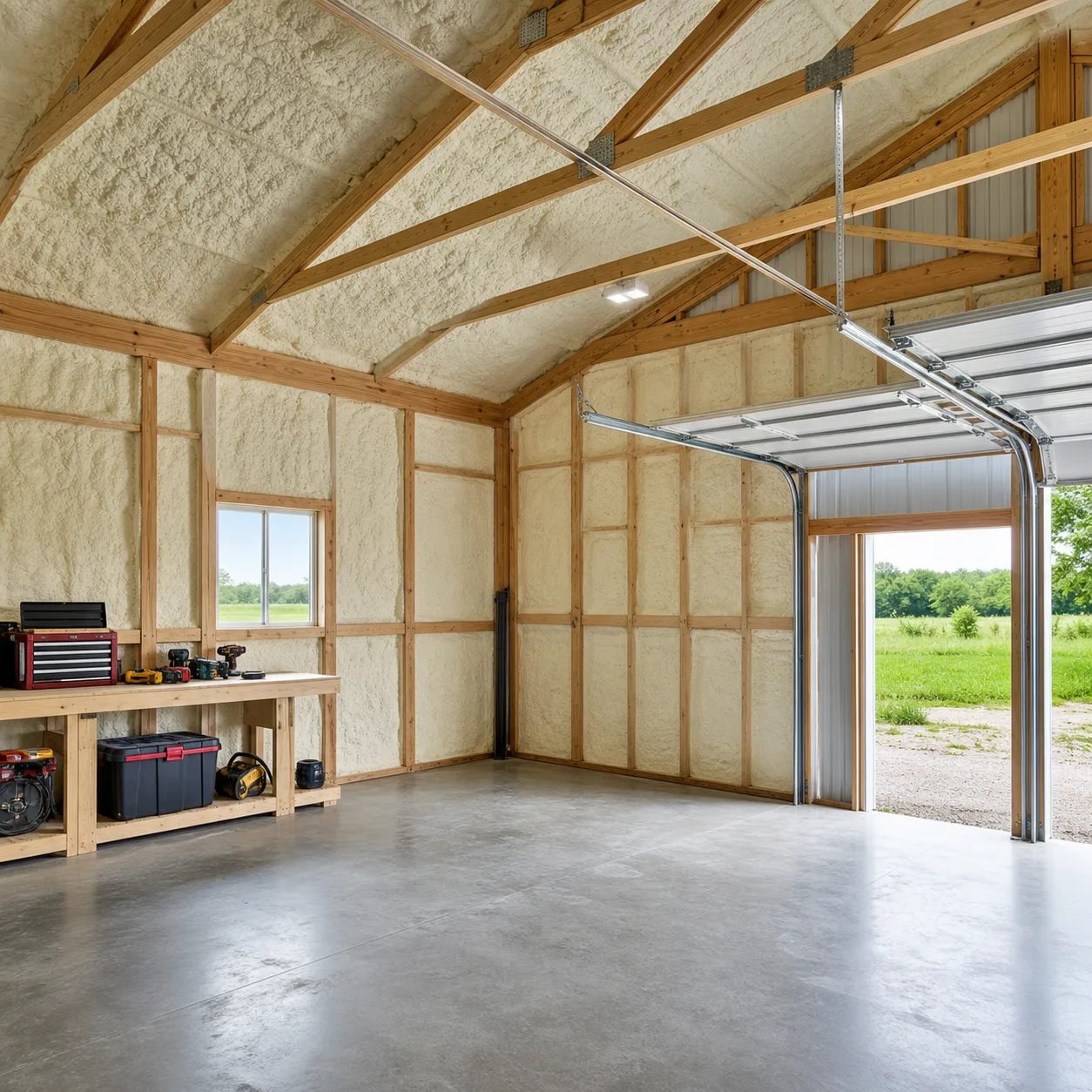
The strongest requests link the main problem to a specific area such as attic, crawl space, rim joist, metal building, garage, shop, pole barn, or commercial space.
Why the lowest quote is not always the best value
A significantly lower quote can sometimes mean thinner foam coverage, a lower-performing product, or skipped prep work rather than a better deal. Compare foam type, depth, and prep scope alongside price, and ask what happens if unexpected conditions (hidden moisture, unusual framing) are found once work begins.